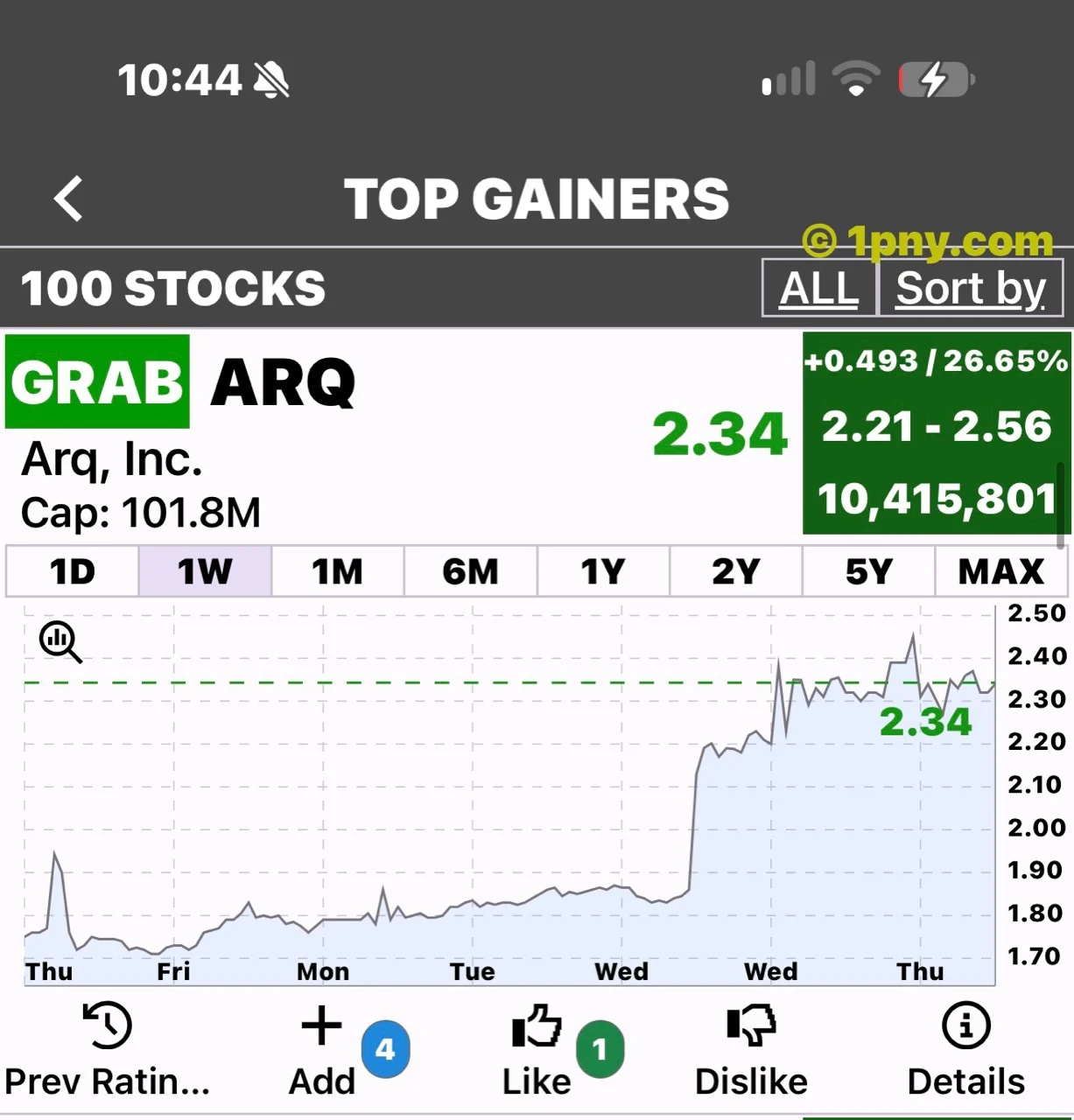
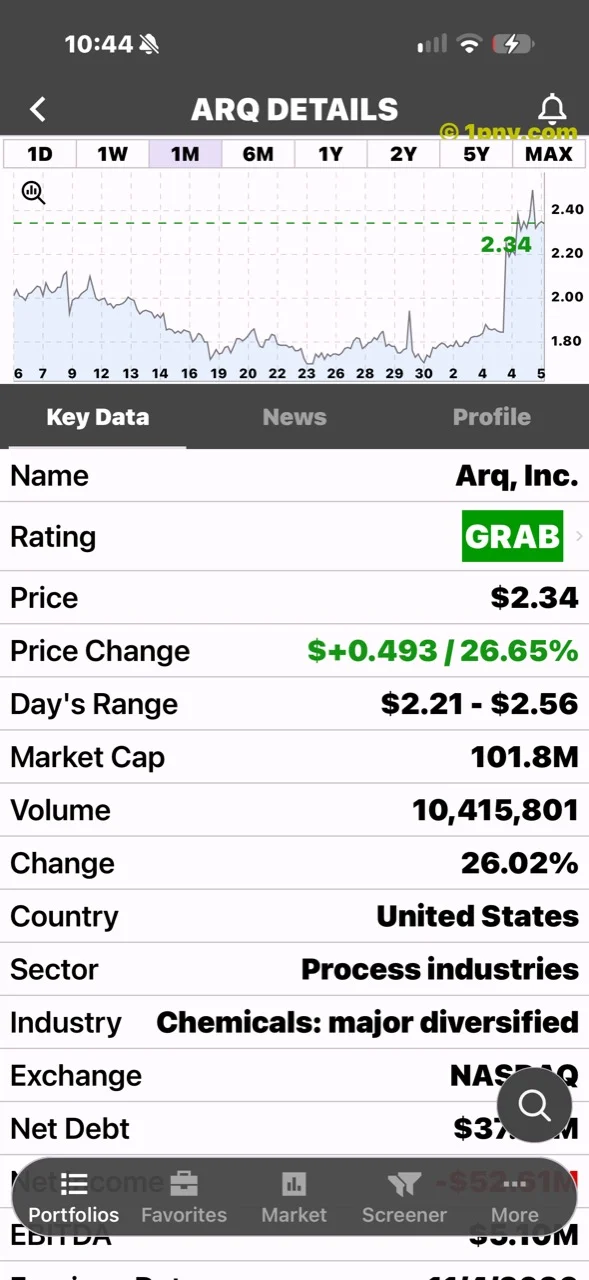
Arq (NASDAQ: ARQ) offers an earnings-based story behind its appearance in the reader-supplied PennyGems screenshots. The stock-specific chart and key-data screen, bearing a 10:44 phone timestamp, show $2.34, a gain of 26.65%, and volume of 10,415,801 shares. The earlier gainers list showed $2.34 and a 26.49% gain. These are separate market snapshots, not live quotes or a verified closing price.
The more durable development is the company's November 4 third-quarter report. It gives readers something more concrete to examine than trading enthusiasm: revenue, margins, earnings and the availability of cash.
Higher revenue came with better margins
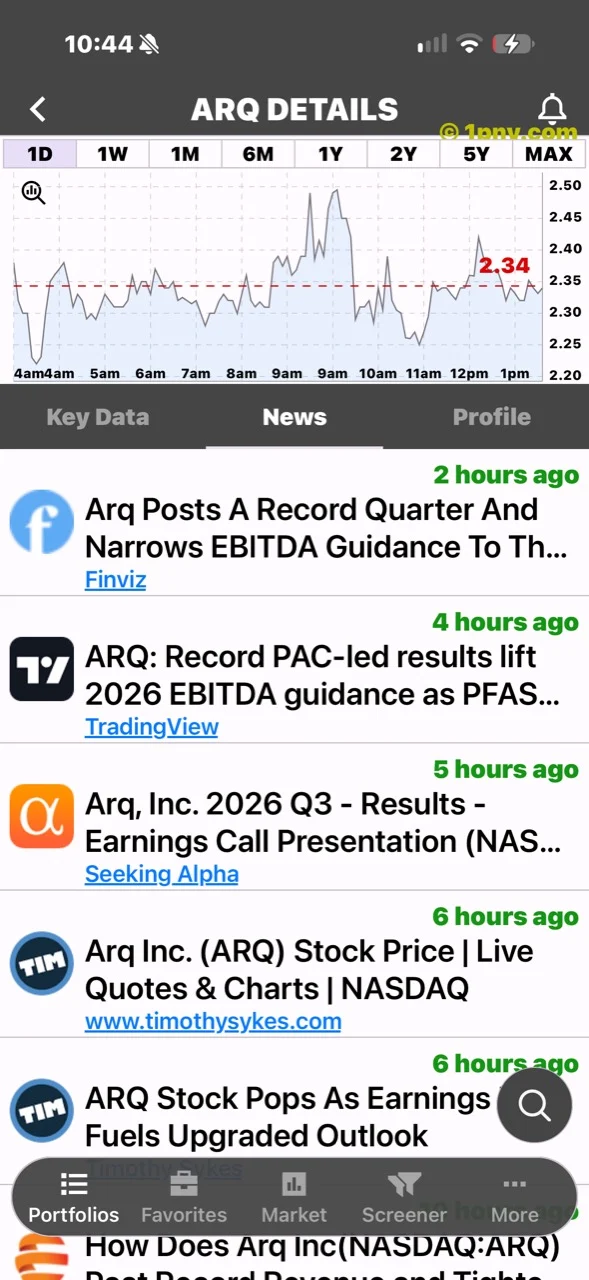
Arq reported quarterly revenue of $38.2 million, up 9%, and gross margin of 39.7%, compared with 28.8% a year earlier. Net income was $2.5 million versus a prior-year loss of approximately $0.9 million, as adjusted. Adjusted EBITDA reached $8.8 million. Management attributed the improvement to strength in its powdered activated carbon business. [Read Arq's results](https://ir.arq.com/news/arq-reports-third-quarter-2026-results/02c37ec9-5954-4de4-9ada-2aa14502735b).
The combination matters analytically. Revenue growth alone can be expensive if a company must sacrifice pricing or absorb higher costs to generate it. When gross margin improves as well, a larger share of each sales dollar remains available to cover the rest of the business.
That does not make one quarter a permanent earnings level. A reader should ask whether the improvement reflects repeatable operating conditions, favorable timing or some combination. Comparing several periods can help separate a developing pattern from a particularly strong quarter.
Activated carbon is a purification business
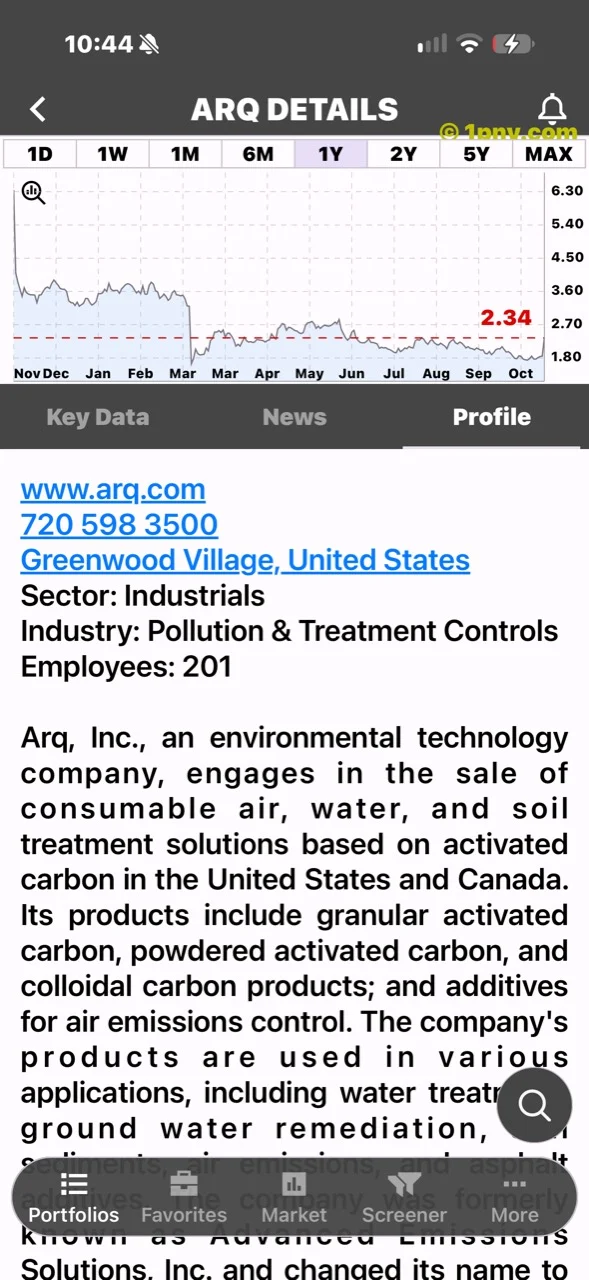
Arq describes its products as serving purification and sustainable-materials applications. Its [investor-relations materials](https://ir.arq.com/) provide company presentations, financial reports and additional operating context.
Activated carbon should not be confused with carbon-credit trading. The investment question here concerns physical products, customers, manufacturing and cash generation. That distinction matters because a broad environmental theme says little about the economics of a particular producer.
A useful way to assess a manufacturing story is to follow the path from customer demand to production, shipment, recognized revenue and payment. Bottlenecks can emerge at different points. Strong demand is valuable, but investors ultimately need evidence that the company can fulfill it economically and collect the proceeds.
The cash headline needs its qualification
Arq ended the quarter with $19.1 million in cash, but only approximately $7.8 million was unrestricted. Its updated full-year adjusted EBITDA range was $19 million to $20 million, while revenue guidance remained $120 million to $125 million.
The unrestricted amount is the relevant starting point when thinking about readily available liquidity. Treating all reported cash as equally accessible would overstate financial flexibility. Investors still need to read the balance sheet, restrictions and future obligations together.
Adjusted EBITDA also differs from net income and operating cash flow. It is useful for comparing selected aspects of operations, but it cannot by itself answer whether the company can fund capital spending, meet financing obligations or avoid additional capital raises.
What to watch after the rally
The next checkpoints are repeatable margins, cash conversion and execution against management's outlook. A stronger operating quarter can improve confidence without removing project or financing risk. Guidance is management's forecast, not a guaranteed outcome.
The screenshot establishes that ARQ attracted substantial trading interest at the captured moment. It does not establish that the entire move was caused by the earnings release. The case for following the stock is more specific: operating progress is now visible, and subsequent reports can test its durability.
Screenshot credit: PennyGems / 1pny.com. Figures from the screen are historical snapshots; this analysis is not a price target or a recommendation to buy.